
The marketing function zeroes in on the seven (7) Ps of marketing. The 7Ps are: Positioning, Product, Packaging, Place, People, Promotion and Price. Marketing is about creating and accumulating customers. It discusses the role of marketing in business strategizing as represented in the form of a marketing plan. The marketing plan contains the enterprise’s 7Ps and the marketing strategies that would allow the enterprise achieve its goals. The discussion of the 7Ps revolves around the marketing function as it serves the overall business strategy.
The 7Ps [of marketing] are: Positioning, Product, Packaging, Place, People, Promotion and Price.
The topic on positioning is taken from three inter-linked perspectives: enterprise, competitive and customers’ perspectives. The stronger the linkages among these three perspectives, the more defined is the positioning of an enterprise in the market place.
Product is the tangible good or the intangible service that the enterprise offers its customers. They are often identified under certain brands which are essential to distinguish them from competitors’ products or services. There are four general types of products: breakthrough, differentiated, copycat and niche products.
Packaging, as discussed in this chapter, is more than just the external covering wrapped around the product but more importantly, it identifies the product and differentiates it from competitors. It also protects and lengthens the lifespan of the product and extends its usefulness. On the other hand, packaging can also mean the bundle of products or services that are put together to attract and delight customers. This also translates to packaging as the marketing medium that would create a favorable perception for the product or service.
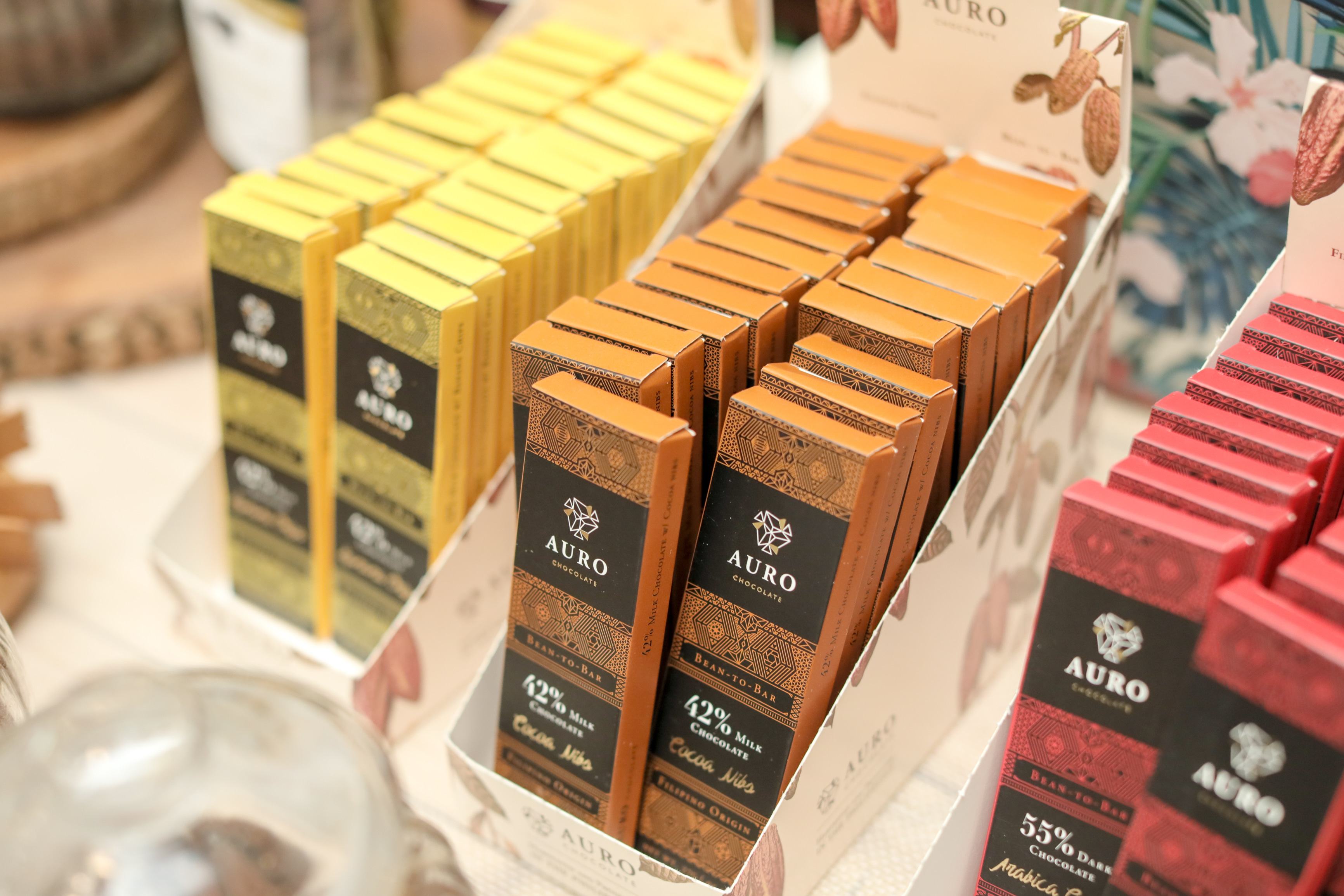
Auro Chocolates, 2018 BPI Sinag Top 20
The fourth P is place or location. Locating in the best place possible is the most compelling marketing strategy for many enterprises. Place could also spell out the product or service’s positioning statement. For some enterprise, place itself is the main selling proposition.
The fifth P is people – the ultimate marketing strategy. People are the regular contact points between the enterprise and its market. It is also a marketing strategy paramount in the service industry, particularly in the hospitality business. In other words, people in the enterprise play a crucial role in the success of the organization.
Promotion is the explicit communication strategy adopted by an enterprise to elicit the patronage, loyalty and support not only of its customers but also of its other significant stakeholders. Effective promotion depends on three critical factors: the credibility of the communicator; the message and the medium of the message; and the receptiveness of the audience to all that is being communicated.
Finally, price – the seventh P. if product positioning occupies the first notch (of the seven), price caps it all together. Price is dependent on the product positioning chosen and the business objectives set by the enterprise. There are several possible pricing objectives: (1) profit maximization; (2) revenue maximization; (3) market share maximization; (4) attainment of the desired prestige or quality leadership; (5) penetration, survival or liquidation; (6) scarcity pricing or market skimming; (7) cost recovery; (8) subsidy pricing; (9) marginal pricing; and (10) others.
If you are interested in reading the full material, visit www.bayanacademy.org.